
Coagulation & Thrombosis Models: When to Use Venous Stasis vs FeCl3 Arterial Thrombosis, and How to Interpret Readouts

Preclinical thrombosis research depends on model selection that mirrors the clinical vascular bed under investigation. Venous stasis and ferric chloride (FeCl3) arterial thrombosis models generate different clot compositions, kinetics, and pharmacological responses. Choosing a model that does not align with your compound's mechanism can produce data that neither advances the program nor supports translational claims.
Two coagulation platforms dominate small-animal thrombosis research, each with distinct triggers and biological readouts. Venous stasis produces fibrin-rich clot formation under low-shear conditions characteristic of deep vein thrombosis. FeCl3 induces platelet-rich occlusion under high-shear arterial flow, aligning with the biology of arterial thrombotic events.
What Distinguishes Venous Stasis from FeCl3 Arterial Thrombosis Models?
Venous stasis creates fibrin-dominant clots through flow restriction and endothelial activation, reflecting the biology of deep vein thrombosis. FeCl3 arterial thrombosis produces platelet-rich occlusive clots through oxidative endothelial injury under high shear. Your candidate's mechanism of action, whether it targets the coagulation cascade or platelet activation, should drive which model you select for efficacy testing.
When Venous Stasis Best Reflects Your Compound's Target

Venous stasis models suit programs developing anticoagulants that target the coagulation cascade, particularly factor Xa, thrombin, and factor XI inhibitors. The procedure involves partial or complete venous ligation of a vein of the appropriate diameter, generating low-shear conditions that favor fibrin polymerization over platelet aggregation. Primary readouts include clot weight and clot length measured at fixed endpoints as well as microscopic examination of the clot, supported by circulating markers such as D-dimer and thrombin-antithrombin complexes.
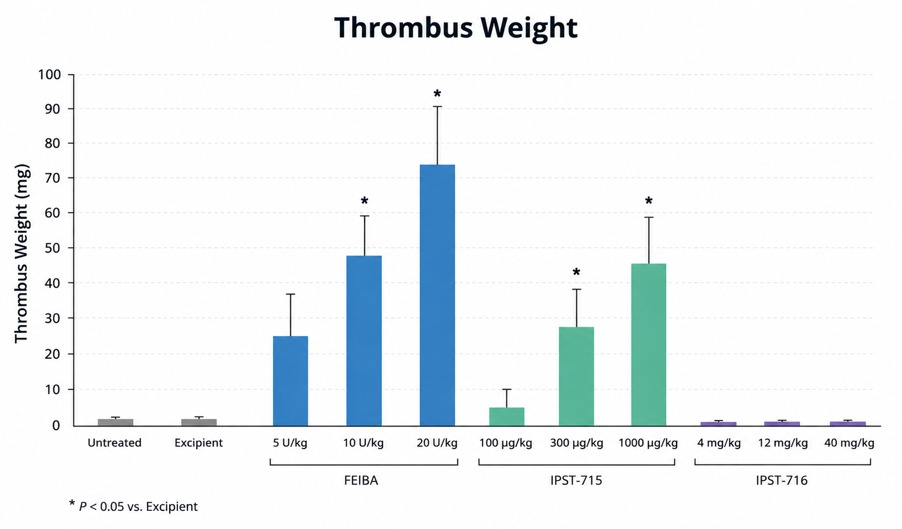
The translational rationale is well-established. Venous thromboembolism affects approximately 900,000 Americans annually, according to CDC, and the model reproduces pathophysiology observed in postoperative and immobility-associated thrombosis. Consequently, efficacy data generated in venous stasis carry direct relevance for indications such as deep vein thrombosis prophylaxis and treatment.
Robust venous stasis studies typically incorporate the following interpretive anchors:
Clot weight reduction quantified against vehicle controls, with pharmacokinetic sampling at the efficacy timepoint to establish exposure-response relationships
Coagulation function markers such as prothrombin time and activated partial thromboplastin time to confirm target engagement
Standardized bleeding assessment, including bleeding time and quantified blood loss, in parallel cohorts at comparable drug exposures to assess the balance between antithrombotic efficacy and impairment of haemostasis.
The model has known limitations. Platelet activation contributes minimally to clot formation under low-shear stasis conditions, making venous stasis poorly suited to antiplatelet compounds or programs targeting shear-dependent thrombosis biology. Sponsors developing agents against those mechanisms should look elsewhere in the coagulation model portfolio to match their pharmacology to the appropriate vascular environment.
How FeCl3 Arterial Thrombosis Captures Platelet-Driven Mechanisms
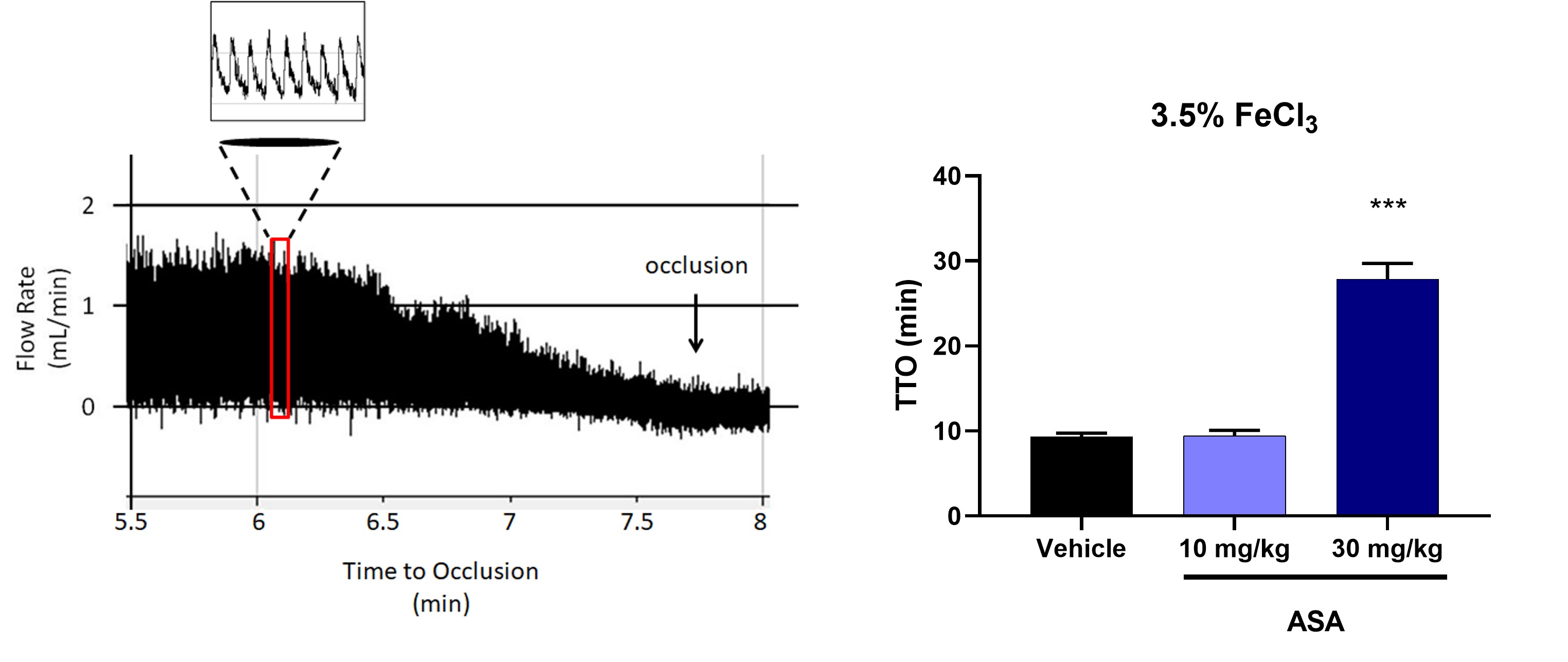
FeCl3 application to the carotid or femoral artery generates reactive oxygen species that denude the endothelium and expose subendothelial matrix. Platelet adhesion, activation, and aggregation follow within minutes, producing occlusive thrombosis under arterial shear conditions. The primary readout is time to occlusion, measured by Doppler flow probes, with retrieved thrombi characterized histologically for platelet-fibrin composition.
Calibrating FeCl3 Concentration and Application Time
FeCl3 concentration and exposure duration directly determine injury severity, thrombus stability, and assay sensitivity across cohorts. Concentrations between five and twenty percent produce a graded injury response, with higher doses generating faster occlusion at the cost of reduced dynamic range for detecting drug effects. Pilot studies to establish concentration-response relationships in your chosen vascular bed and species are therefore essential before initiating a formal efficacy program.
Antiplatelet compounds targeting P2Y12, GPIIb/IIIa, or thromboxane pathways typically produce dose-dependent extension of occlusion time in the arterial thrombosis model. Direct thrombin and factor Xa inhibitors show weaker or absent effects, reflecting the platelet-dominated nature of the clot. Additionally, histological confirmation of thrombus composition validates mechanistic interpretation and distinguishes model-appropriate from off-target effects.
Bleeding endpoints deserve equal attention in arterial thrombosis programs. Antiplatelet agents carry inherent hemorrhagic risk that must be characterized alongside efficacy to support later development decisions. Published examples on the publications page illustrate how integrated endpoint packages strengthen the interpretive value of preclinical thrombosis data.
Interpreting Readouts and Avoiding Common Analytical Pitfalls
Thrombosis readouts require statistical frameworks appropriate to their underlying data distributions and censoring patterns. Time-to-occlusion data in FeCl3 studies often include censored observations when animals reach the observation endpoint without occluding, and Kaplan-Meier survival analysis with log-rank testing handles this censoring appropriately. Clot weight data from venous stasis typically follow log-normal distributions, requiring transformation before parametric testing.
Variability between surgeons, cohorts, and study days introduces confounds that undermine interpretation when uncontrolled. Stratified randomization, blinded readout assessment, and inclusion of vehicle and positive control arms in every study anchor effect sizes and protect against systematic bias. The positive control choice matters: heparin or enoxaparin for venous stasis, aspirin or clopidogrel for FeCl3, matched to the mechanism the model actually engages.
Several recurring pitfalls compromise thrombosis study interpretation:
Underpowered designs that fail to detect biologically meaningful effects, particularly for compounds with moderate rather than dramatic activity
Absence of exposure measurement at the efficacy timepoint, which obscures pharmacokinetic-pharmacodynamic relationships and prevents dose selection for later studies
Efficacy readouts reported without parallel bleeding assessment, which produces data lacking therapeutic index context
Overinterpretation of single-timepoint readouts when kinetic characterization would reveal onset, duration, and reversibility

Robust programs pair primary efficacy endpoints with mechanistic biomarkers and safety pharmacology to generate decision-ready evidence. The scientific direction team works with sponsors to design endpoint panels matched to the compound's therapeutic hypothesis and intended clinical positioning.
Matching Model to Mechanism
Model selection between venous stasis and FeCl3 arterial thrombosis should follow directly from your compound's mechanism, intended indication, and the development question you need to answer. Poor alignment between model biology and drug target produces data that neither advances the program nor supports regulatory submissions, regardless of how well the study itself was executed. The more useful question is not which model is more rigorous, but which model generates the evidence your next development decision actually requires.
IPS Therapeutique has supported thrombosis programs across cardiovascular and hematology indications from our Sherbrooke facility for over two decades. Our scientific directors work with sponsors to select the appropriate model, calibrate injury parameters, and design endpoint panels that integrate efficacy, mechanism, and safety within a translational framework. To discuss your thrombosis program with our team, get in touch through our contact page.


Comments